Why Steering Long-Running AI Work Is the Next Real AI Skill
As AI work becomes asynchronous and tool-connected, the real skill shifts from asking one good question to steering active work threads with boundaries, reviews, and business goals.

Tobias Holmgren
Practical AI agents, automation workflows, and reviewed business systems.
Published May 19, 2026
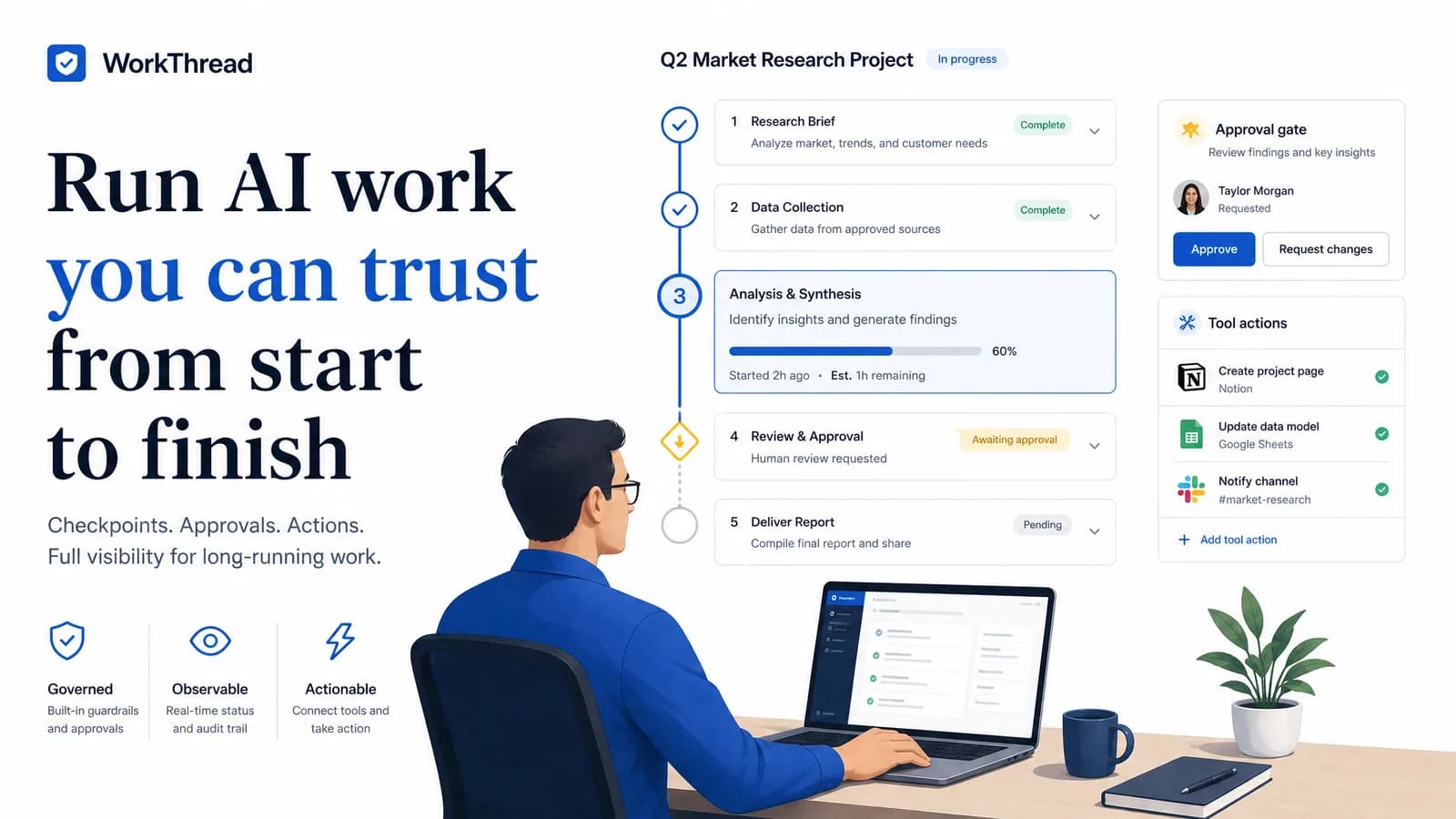
A lot of AI advice still sounds like this: write a better prompt, ask a smarter question, get a better answer. That was a useful mindset when AI mostly lived inside a chat box. It is already becoming incomplete.
The more important shift now is that AI can work across time, tools, and steps. It can continue a task, use connected systems, pause for approval, recover from feedback, and finish later. Once that happens, the real skill is no longer just prompting. The real skill is steering.
Prompting gets an answer. Steering gets managed work.
Key takeaways
The next useful AI skill is managing ongoing work, not just asking one good question.
Long-running AI tasks need goals, boundaries, checkpoints, and approvals.
The value comes from oversight and workflow design, not just model quality.
Businesses that learn to steer AI work will get more reliable results than teams that only learn prompting.
What changed
For a while, AI use looked like one person opening a chat tool, asking for something, and copying the output somewhere else. Now the model is being connected to more of the actual workflow.
It can keep working after the first request
It can use tools and connected systems
It can pause and wait for approval
It can resume later with context
It can send status updates while the work is still in progress
It can handle exceptions instead of failing silently
If the system is doing work over time, somebody needs to define the goal, watch the boundaries, approve sensitive steps, and redirect when the task drifts. That is a different skill from writing a good one-shot prompt.
What long-running AI work means in simple terms
Long-running AI work is any task where the system does more than return a single answer. Instead, it moves through a sequence.
A user or trigger starts the task
The AI gathers context
It takes one or more tool actions
It pauses if confidence is low or approval is required
A human reviews, redirects, or approves
The system continues until the task is complete
The outcome is logged and reviewed
That might sound technical, but the business meaning is simple: AI is moving from assistant mode into worker mode.
Why prompting is no longer enough
Prompting still matters. Clear instructions always help. But once AI starts operating inside a workflow, prompting becomes only one part of the picture.
What is the exact outcome we want?
Which tools can the AI use?
What actions need approval?
What should happen when the task is uncertain?
Who owns the exception queue?
How do we know the system is actually saving time?
Those are steering questions. And they matter more than tiny prompt improvements once the work becomes ongoing.
One-off prompting | Steering long-running AI work |
|---|---|
Ask for one answer | Manage a process over time |
Main focus is wording the request | Main focus is defining goals, permissions, and checkpoints |
Usually no memory beyond the session | Context carries across steps and reviews |
Output is often copied manually | Output can trigger actions, approvals, or follow-up tasks |
Failure is usually just a weak answer | Failure can create business risk if controls are weak |
Success depends heavily on prompt quality | Success depends on workflow quality and human oversight |
What steering looks like in practice
Imagine an AI task that prepares a weekly competitor brief. A one-off prompt might give you a decent summary. A steered long-running workflow can do something more useful.
Pull the latest source list
Gather updates from selected sites or feeds
Cluster the items by theme
Draft the summary
Flag uncertain claims for review
Ask for approval before distribution
Save the final version to the right place
Log what happened and what needed intervention
In that setup, the prompt still matters. But the bigger value comes from the operating design around it.
Why this matters for business
This is not just a developer trend. It matters because the companies that get value from AI will increasingly be the ones that know how to run AI work safely and repeatedly.
Less manual follow-up work
Fewer lost tasks between tools
Better visibility into what the system did
Clearer ownership when a task needs human judgment
More confidence that automation is helping instead of creating hidden mess
In other words, steering is the layer that turns impressive AI demos into dependable business output.
The tradeoff
Pros
Makes AI useful beyond one-off answers
Supports real workflows across time and tools
Improves consistency in repeated tasks
Creates better visibility through approvals and logs
Gives teams a more scalable way to manage routine work
Cons
Needs clearer ownership than simple chat usage
Requires permissions, review rules, and exception handling
Can create hidden errors if status and logging are weak
Takes more setup than dropping a chatbot into the business
Start with bounded tasks
Do not begin with something vague like run marketing or manage support. Start with a narrow task that has a clear start point, allowed tools, review gates, and an obvious success measure.
How to build this safely
Pick one repeated task that already has a known owner
Define the goal in business terms, not tool terms
Limit what the AI can read, change, or send
Add approval points for sensitive actions
Set rules for uncertainty, failure, and escalation
Log outcomes and review exceptions
Expand only after the workflow proves reliable
FAQ
Is prompting still important?
Yes. Good prompting still improves quality. It is just no longer the whole job once AI is handling work over time.
Who needs this skill first?
Founders, operators, technical leads, and anyone responsible for workflows where AI can take actions or move work between tools.
Does this only matter for advanced engineering teams?
No. Even small teams will run into this as AI becomes more connected to email, documents, CRM systems, support queues, and internal processes.
What is the biggest mistake to avoid?
Treating an active AI workflow like a harmless chat tool. Once the system can act, pause, resume, and route work, it needs ownership and controls.
Final takeaway
The early AI wave rewarded people who learned how to ask good questions. The next wave will reward people who can manage active AI work.
That means setting goals, limiting permissions, adding approvals, watching exceptions, and keeping the system pointed at a real business outcome. Prompting still matters, but prompting is no longer the whole game.