What a Real GEO Workflow Looks Like Now That Google Is Making It Official
GEO is no longer a vague side topic. As Google formalizes generative AI optimization, the real advantage comes from a repeatable workflow built on evidence, expert framing, page structure, and visibility review.

Tobias Holmgren
Practical AI agents, automation workflows, and reviewed business systems.
Published May 20, 2026
A lot of brands still treat AI visibility like a mystery channel. They hear terms like GEO, AI search, AI Overviews, answer engines, or citations in generative search, and then jump straight to tactics. Usually that means schema tweaks, FAQ blocks, or trying to force keywords into pages that were weak to begin with.
That is not a workflow. And it is becoming a bigger problem now that Google is openly documenting generative AI optimization as a real part of search. The important takeaway is not that there is a new trick to learn. It is that brands now need a repeatable GEO process built around source quality, expert framing, structured publishing, and review.
GEO is not one more SEO checkbox. It is a content operations workflow.
Key takeaways
Google formalizing generative AI optimization makes GEO harder to ignore.
Most brands do not need a hack. They need a process.
The strongest GEO content is usually evidence-rich, well-structured, and written from a clear point of view.
Schema can help, but it cannot rescue weak source material or vague pages.
Teams that review visibility and citation patterns will learn faster than teams that only publish and hope.
What changed
For a long time, AI visibility sat in an awkward place between SEO, content, and experimentation. Now Google is making it more explicit. That matters because it changes the conversation from maybe this matters later to this is now part of how search visibility works.
But there is also a trap here. When a new search layer becomes more visible, the market usually responds with shortcuts. People look for a tactic they can bolt on quickly. That is the wrong frame. If generative systems are selecting, summarizing, and citing content, then the real work moves upstream.
How you gather and verify source material
How clearly you explain the topic
How well each page answers the actual business question
How consistently you publish structured, useful pages
How you review what gets picked up and what does not
What GEO means in practical terms
In simple language, GEO is the work of making your content easier for generative search systems to understand, trust, extract, and cite. That does not mean writing for robots. It means making your pages more useful, more explicit, and easier to retrieve.
Answers a clear question or job to be done
Includes specific evidence, examples, or experience
Uses clean page structure so the important points are easy to extract
Avoids vague filler language
Matches the real intent behind the search
This is why GEO overlaps with good SEO, but is not identical to old SEO habits. The content has to be easy to rank, easy to read, and easy to cite.
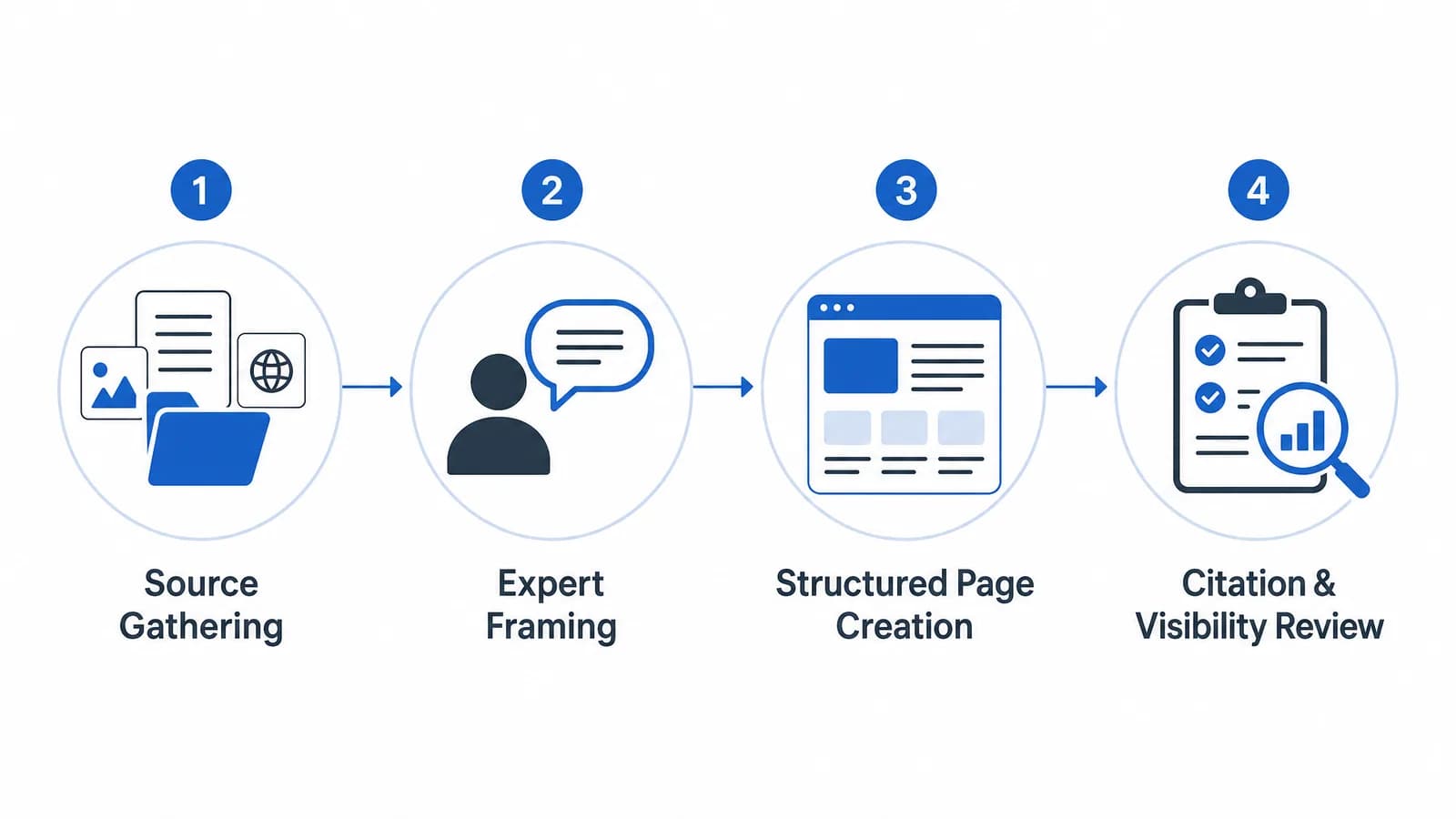
What a real GEO workflow looks like
Most teams stop at content creation. A real GEO workflow starts earlier and ends later.
1. Source gathering
Collect strong raw material before writing. That might include first-party data, internal process knowledge, customer questions, product details, trusted external sources, and examples from real implementation work. If the source layer is weak, the page usually becomes generic.
2. Expert framing
Turn raw material into a clear point of view. This is where most AI-assisted content fails. It can summarize, but it does not automatically create a useful business angle. Someone still needs to decide what the real takeaway is, what confusion the page should clear up, which tradeoffs matter, and what claim can actually be supported.
3. Structured page creation
Now the page gets built in a way that is easy for both humans and AI systems to understand. That means a clear title and angle, strong subheadings, direct answers near the top, specific lists and comparisons where useful, concrete examples instead of generic claims, and supportive markup and metadata where relevant. This is where schema belongs: as support work inside the page system, not as the strategy itself.
4. Citation and visibility review
After publishing, review what happened. Look for signals such as whether the page is being surfaced or cited, which phrasing seems extractable, which sections are too vague, whether the page answers the full question, and where competitors are more specific or better evidenced. Without this review step, most teams never improve their GEO process. They just keep shipping pages blindly.
Why most teams still miss the point
The common mistake is treating GEO like a formatting problem. It is usually a workflow problem. Teams often publish pages with no real evidence behind them, ask AI to draft before they clarify the actual angle, over-focus on technical markup, ignore whether the page is genuinely useful to quote or summarize, and skip post-publish review. That creates content that is technically present but strategically weak.
Tactic-first GEO | Workflow-first GEO |
|---|---|
Starts with tricks, templates, or schema | Starts with source quality and audience questions |
Measures output volume | Measures usefulness, extractability, and visibility |
Treats AI visibility as a publishing feature | Treats AI visibility as a content system |
Optimizes the page after weak thinking | Improves the thinking before the page is built |
Assumes one-time publishing is enough | Includes review and iteration after publication |
Produces generic pages faster | Produces stronger pages that are easier to cite |
What to put on the page if you want stronger AI visibility
You do not need to overengineer every article. But you do need enough structure and substance to deserve retrieval.
State the question clearly
Give the business meaning early
Include proof, examples, or real-world specifics
Break the topic into scannable sections
Add comparisons, steps, or FAQs where they genuinely help
Remove vague filler
Support the page with clean metadata and schema where appropriate
The key idea is simple: make the useful part obvious. If a human skims the page and still cannot see the answer quickly, an AI system will struggle too.
How to start without overcomplicating it
Pick three important business questions your market is already asking
Gather stronger source material than your competitors are using
Create pages that answer those questions directly and specifically
Add structure that makes the key points easy to extract
Review how those pages perform in search and AI-driven experiences
Improve the workflow, not just the wording
Do not treat GEO like a loophole hunt
If your workflow produces thin pages with recycled claims and no source depth, formatting alone will not make them consistently useful in generative search.
FAQ
Is GEO just SEO with a new name?
Not exactly. There is overlap, but GEO puts more pressure on extractability, clarity, evidence, and answer quality in environments where systems summarize content for the reader.
Does schema still matter?
Yes. It helps support structure and understanding. It just should not be confused with the full strategy.
Who should own GEO inside a business?
Usually SEO and content need to share it. The strongest setups also involve subject-matter experts, because evidence and useful framing matter more than publishing volume alone.
What is the biggest mistake to avoid?
Creating generic AI-assisted pages at scale before you have a real source and review process.
Final takeaway
Google making generative AI optimization more explicit does not mean brands need a new hack. It means they need better content operations.
The teams that win here will not be the ones with the loudest GEO claims. They will be the ones with a workflow that turns real source material into clear, structured, evidence-rich pages and then learns from what gets surfaced. That is what a real GEO workflow looks like.