The Real Shift Is Not AI Chatbots. It Is AI Moving Into Your Core Workflows
The next phase of AI is not another chatbot sitting beside the business. It is AI moving inside the systems where work already happens. That changes what companies need to manage: workflow ownership, approvals, integration boundaries, and accountability.

Tobias Holmgren
Practical AI agents, automation workflows, and reviewed business systems.
Published May 25, 2026
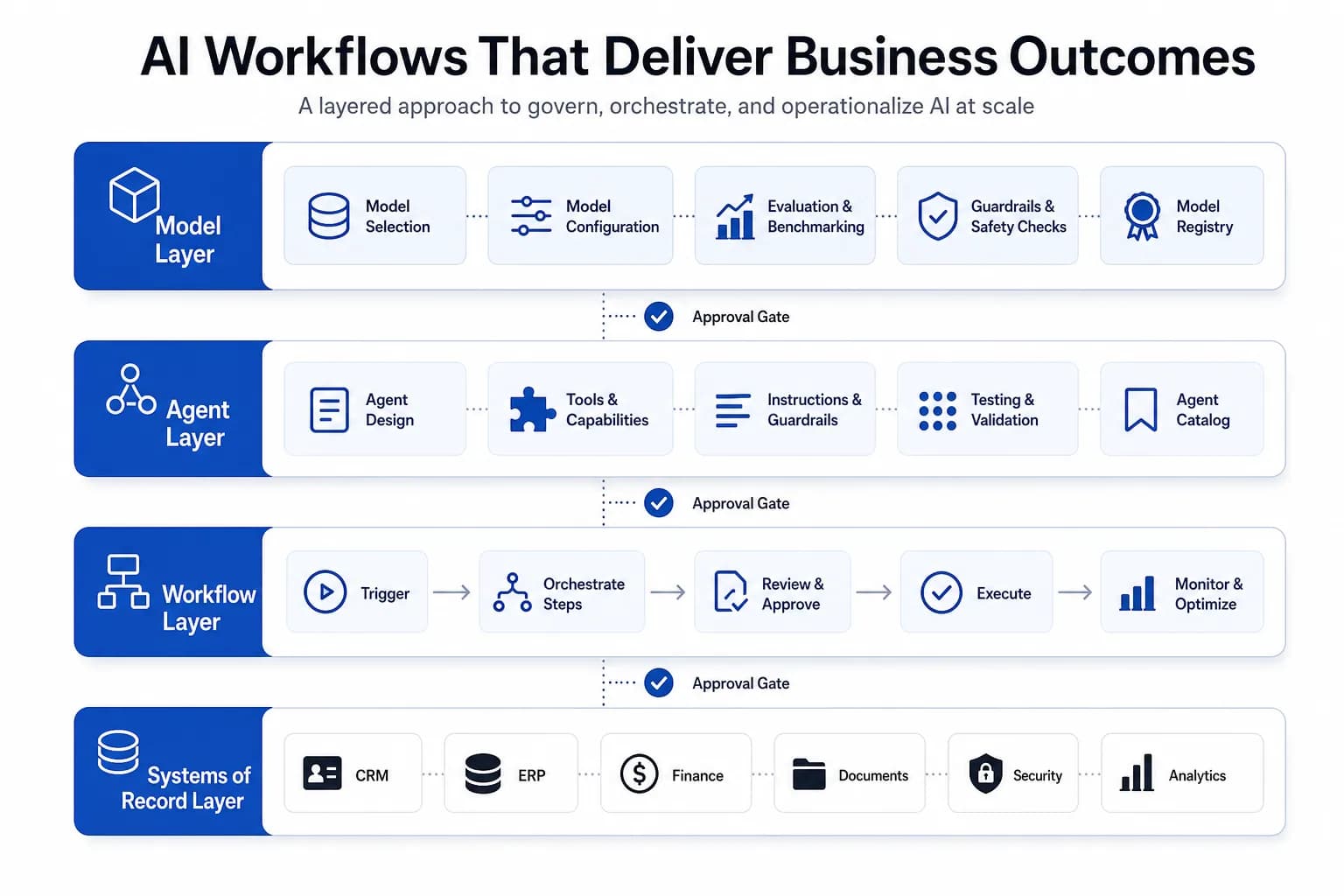
A lot of businesses still think about AI as a chatbot sitting next to the work. That view is already getting old. The more important shift is that AI is moving into the systems where work already happens: CRM tools, ERP platforms, HR systems, support queues, internal operations tools, and automation layers.
That sounds exciting, but it also changes the real business question. It is no longer just which AI tool gives the best answer. It becomes who owns the workflow, what the AI can do without approval, what happens when it gets stuck, and which system remains the final source of truth.
The interesting story is not that software vendors are adding agents. It is that businesses now need an operating model for AI inside real workflows.
Key takeaways
The next phase of AI is not another side-chat. It is AI moving into the flow of real business work.
When AI enters core workflows, ownership matters more than the demo.
The key business questions are approvals, exceptions, accountability, and source-of-truth control.
Companies that define workflow rules early will adopt embedded AI more safely and faster.
A smart agent inside a broken workflow does not fix the workflow. It can scale the confusion.
What is actually changing
For the last couple of years, most AI adoption started at the edge of the business. Someone opened a chatbot, asked a question, copied the answer, and manually moved that output into the next step. Now software vendors are pushing AI deeper into the stack.
Instead of sitting beside the workflow, AI is being placed inside the workflow. That means the AI may read business records, draft or classify updates, trigger follow-up actions, escalate exceptions, and recommend next steps inside the system people already use.
This is a meaningful shift because it changes AI from a productivity assistant into part of the operating model. And once AI becomes part of the operating model, the quality of the business process matters even more.
What this means in simple terms
In plain English, businesses are moving from AI helps a person do a task to AI helps move the task itself through the workflow. That is a big difference. A chatbot can be useful even when the surrounding process is messy. But an embedded agent inside finance, operations, recruiting, support, or sales will immediately expose weak process design.
If the workflow has no clear owner, no approval rule, no exception path, and no clean system of record, AI does not remove the mess. It accelerates it.
Why workflow ownership matters more than the demo
Vendor demos usually focus on what the AI can do. Real businesses need to focus on what the workflow allows. Those are not the same thing. A useful embedded AI workflow usually needs clear answers to five practical questions.
1. What decision is the AI allowed to make?
Drafting a summary is different from updating a payment status, approving a refund, changing a forecast, or escalating a hiring decision. The workflow needs a boundary around which decisions can be automated and which still require a person.
2. Who owns exceptions?
The happy path is easy. The real test is what happens when the AI cannot classify something confidently, the data looks incomplete, or the action touches a higher-risk case. If exceptions have no owner, the workflow will stall or create hidden cleanup work.
3. Which system is the source of truth?
If AI touches multiple tools, one of them still needs to remain authoritative. Otherwise teams end up with workflow drift, conflicting updates, and confusion about where the final answer lives.
4. What approvals are required?
Embedded AI should not create silent operational changes where nobody knows what happened until later. Approvals do not need to block everything, but higher-risk actions should have review points, and those review points should be designed into the workflow from the start.
5. How is performance reviewed?
If AI is inside the workflow, then output quality alone is not enough. You also need to review time saved, error rate, exception volume, override frequency, and downstream business impact. That is how you decide whether the workflow is actually improving.
Chatbot thinking | Workflow thinking |
|---|---|
Starts with the model experience | Starts with the business process |
Optimizes for response quality | Optimizes for operational outcome |
Treats the user as the main control layer | Treats approvals and workflow rules as the control layer |
Often leaves data movement manual | Designs handoffs and updates inside the process |
Measures usefulness by how smart it feels | Measures usefulness by time, quality, and accountability |
Can tolerate messy surrounding operations | Exposes weak process design immediately |
A practical example
Imagine a support team handling inbound customer issues. The old AI setup might look like this: an agent writes a suggested reply in a chat window, a support person copies parts of it, and the person decides what to send and what system fields to update. That can still be helpful, but the workflow remains mostly manual.
Now imagine the next version. The AI reads the incoming issue inside the support system, classifies the case, drafts the response, proposes tags, priority, and routing, lets low-risk cases move forward automatically, and stops exceptions or sensitive cases for human review. The support platform remains the source of truth. That is not just a better chatbot. That is a workflow design problem.
What businesses should put in place now
Pick one workflow with repeated volume and obvious friction.
Map the current steps before adding AI.
Decide which actions are safe to automate and which need approval.
Define the exception path before launch.
Keep one clear system of record.
Measure business outcomes, not just model quality.
Expand only after one workflow is working reliably.
Tradeoff: moving too early vs moving too late
Pros
Controlled early adoption helps a business design approvals, ownership, and exception paths before complexity grows.
A well-governed first workflow creates a repeatable template for later expansion.
Teams can measure business value faster when the workflow is intentionally designed.
Cons
Embedding AI too early into a messy process can create confusion and cleanup work.
Waiting too long can leave obvious manual work untouched while competitors improve throughput.
Trying to scale without one good workflow first often leads to platform buying before process clarity.
Practical note
Do not let the most impressive vendor demo define your internal design. The right question is not what the agent can do. It is what part of this workflow the business should allow the agent to own.
FAQ
Does this mean chatbots no longer matter?
No. Chatbots still have value. But the bigger business opportunity is when AI helps move work through real systems, not just answer questions beside them.
Why is workflow ownership such a big deal?
Because once AI can act inside a process, somebody needs to own approvals, exceptions, outcomes, and accountability. Without that, AI just adds another layer of confusion.
Should small and mid-sized businesses care about this now?
Yes, especially if they run repeated workflows in sales, support, admin, operations, or reporting. They do not need a giant platform first, but they do need one clearly governed workflow.
What is the biggest mistake to avoid?
Putting AI into a messy workflow and hoping the model will compensate for unclear ownership or weak process design.
Final takeaway
The real shift in AI is not that software vendors can show smarter chat interfaces. It is that AI is moving into the systems where work actually happens. That makes workflow ownership the real management issue. The businesses that win here will be the ones that decide where AI fits, what it can own, when a human steps in, and how outcomes are measured. That is how AI becomes useful inside a real company.