How AI Agents Turn Repetitive Work Into Managed Business Workflows
AI agents are most useful when they are connected to clear workflows, good inputs, human review and measurable business outcomes. This test article shows the structure in plain English.

Tobias Holmgren
Practical AI agents, automation workflows, and reviewed business systems.
Published May 13, 2026
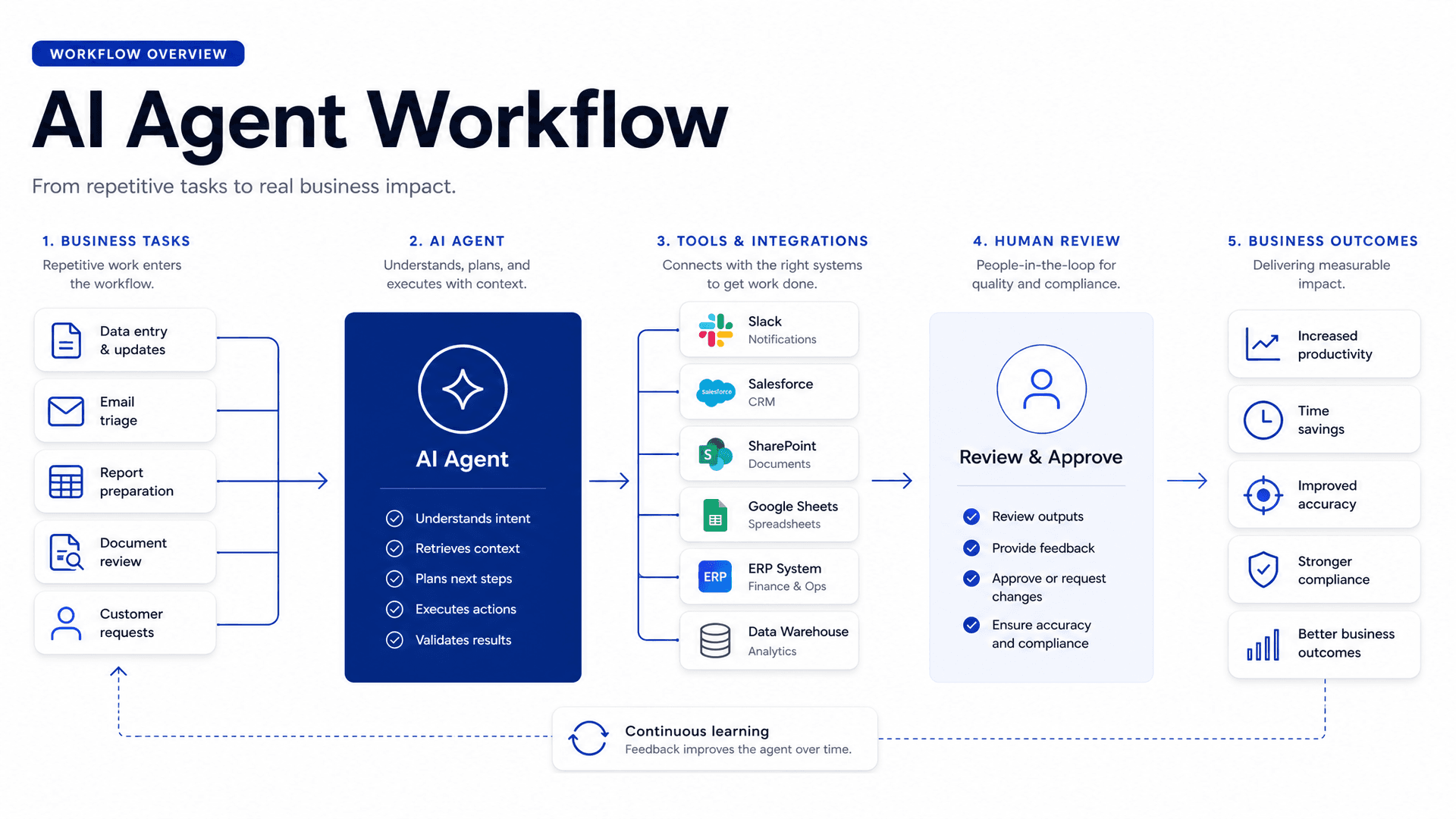
Most companies do not need another AI demo. They need a practical way to turn repeated work into a controlled workflow that saves time without creating new risk.
That is where AI agents become useful. Not as magic workers, but as structured systems that can collect information, follow rules, use tools, prepare outputs and ask for human review when judgment matters.
Key takeaways
AI agents create value when they are connected to clear business workflows, not when they are treated as isolated chatbots.
Management teams should focus on repeated tasks, approval points, quality checks and measurable outcomes.
The safest starting point is one narrow workflow with clear inputs, rules and human review.
Good AI automation removes waste. It should not remove accountability.
What an AI agent means in simple terms
A normal chatbot waits for a person to ask a question. An AI agent can be designed to work through a task: check sources, use tools, make decisions within limits, prepare a result and hand it back for review.
The useful question is not: can AI answer this? The useful question is: can this repeated workflow be made faster, clearer and safer with AI support?
Why this matters for management
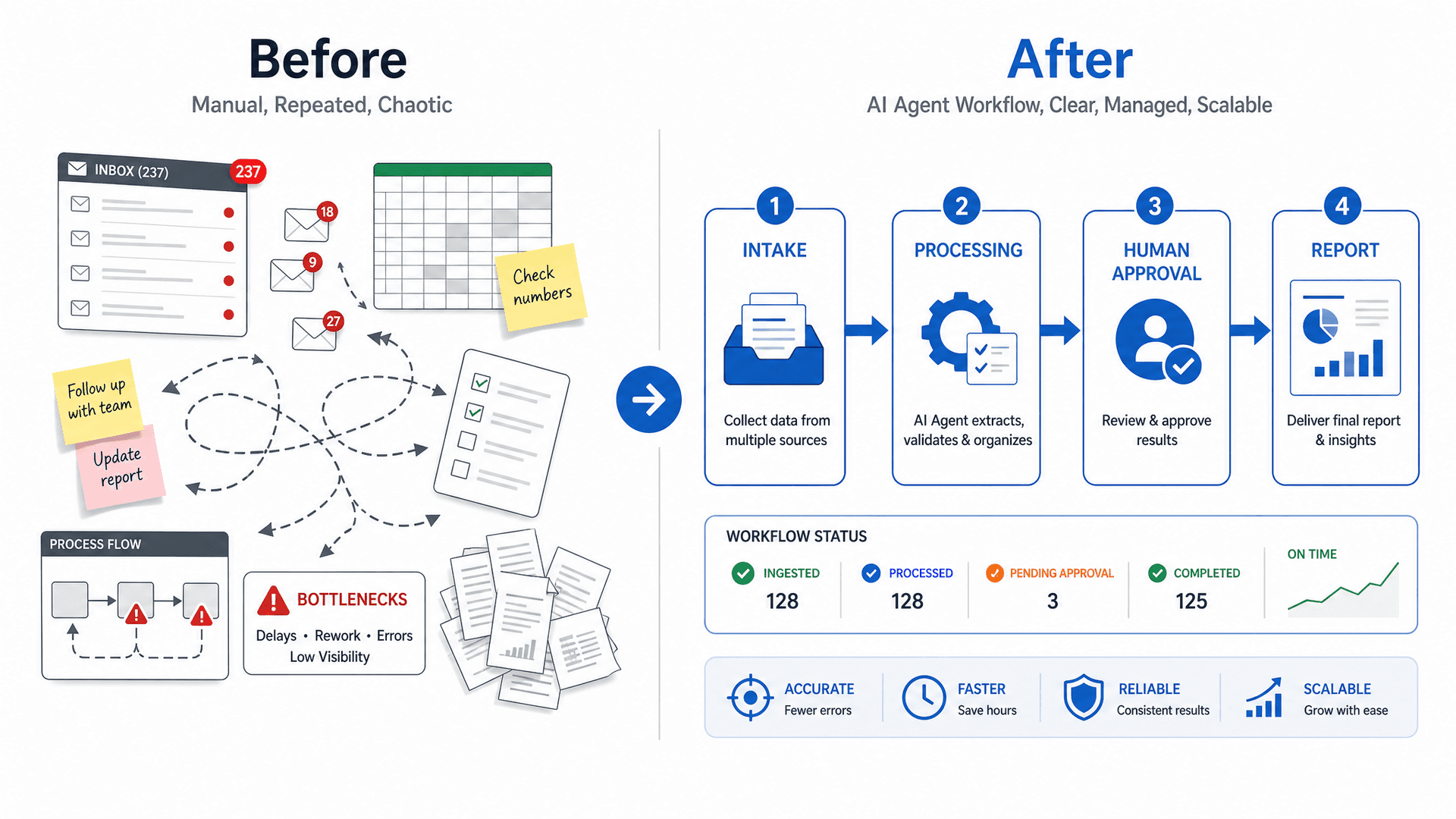
For management teams, the value is not the technology itself. The value is that repeated work becomes easier to measure, easier to delegate and easier to improve.
Less time spent collecting and formatting information.
More consistent reporting and follow-up.
Clearer ownership because the agent prepares work, but people still approve important decisions.
A practical workflow example
Imagine a company wants a weekly competitor and market summary. Without automation, someone has to check competitor websites, read updates, compare pricing pages, collect screenshots and write a report. With an AI agent workflow, the process can be structured.
Define the sources the agent should monitor.
Tell the agent which changes matter: pricing, offers, content, product launches or positioning.
Let the agent prepare a short summary with links and evidence.
Have a person review the findings before strategic decisions are made.
Approach | Best for | Management risk |
|---|---|---|
Manual process | Occasional tasks with low volume | Slow, inconsistent and dependent on one person |
AI-assisted workflow | Repeated tasks with clear rules and review points | Needs guardrails, source checks and approval logic |
The tradeoffs
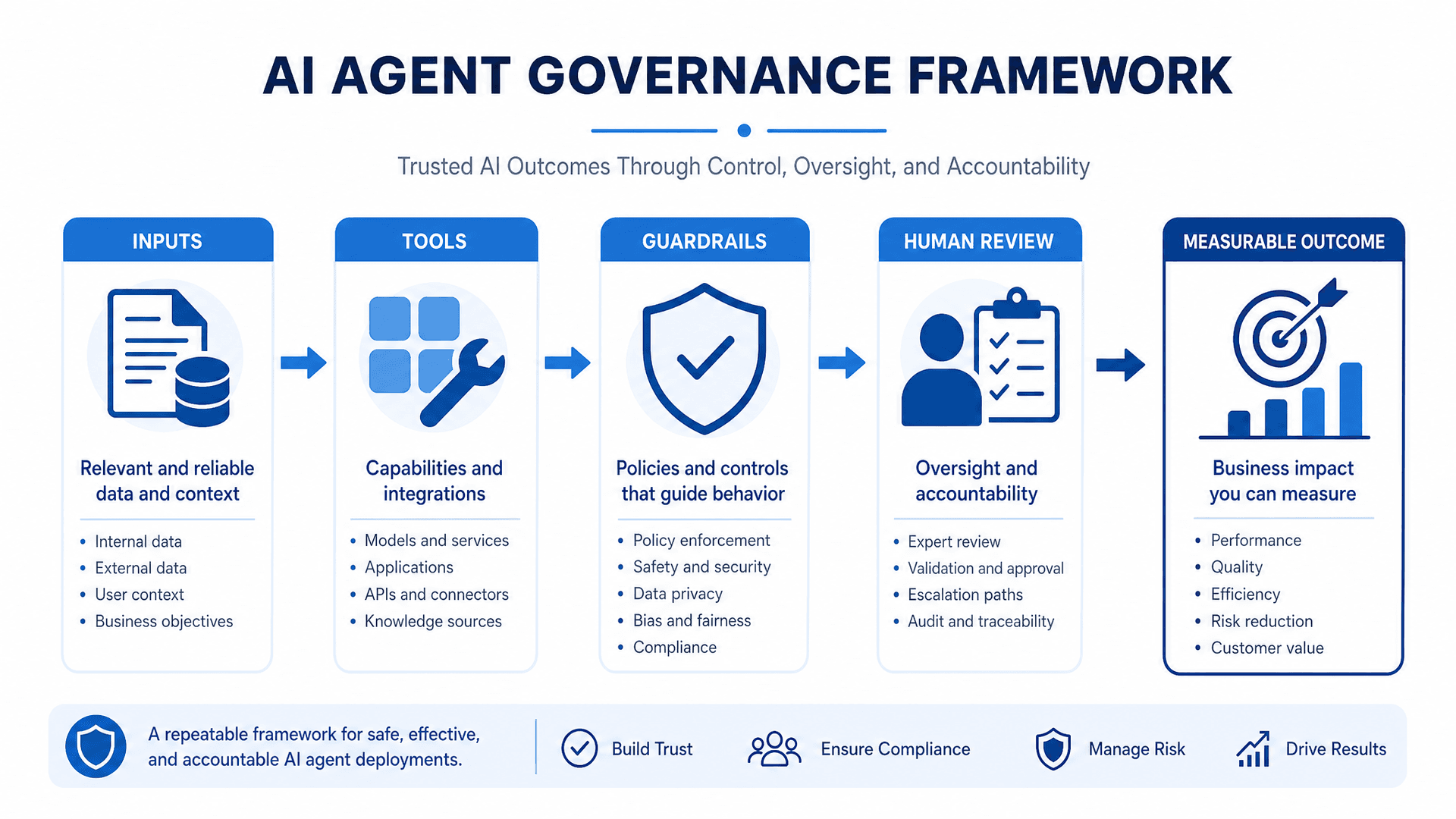
Pros
Faster research, summaries and reporting
More consistent process execution
Better use of specialist time
Clearer audit trail when the workflow is designed properly
Cons
Bad inputs can create bad summaries
Unclear rules lead to unreliable outputs
Over-automation can create noise instead of value
Human review is still needed for judgment-heavy decisions
Practical setup
Start with one repeated workflow that already has a clear owner. If nobody owns the process today, AI will not magically fix that.
A simple technical view
The technical side does not need to be complicated for management to understand. A basic workflow can be described like this:
Input sources → AI analysis → tool actions → human review → approved output → measurement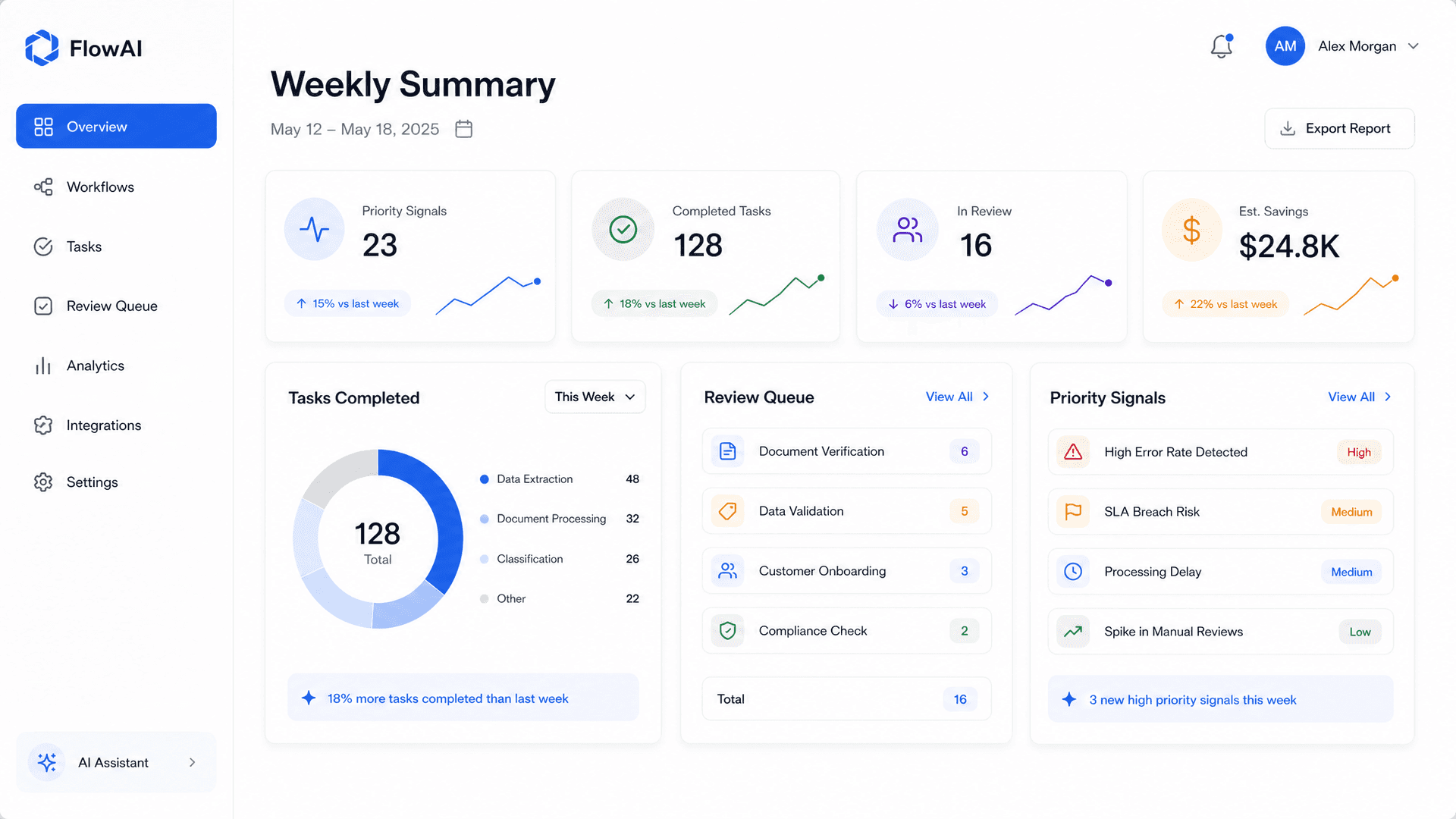
How to start small
Pick one repeated task that consumes time every week.
Write down the current process in plain steps.
Decide which steps the agent may do and which steps require approval.
Test with a small volume before connecting more tools or more data.
FAQ
Should an AI agent make business decisions automatically?
Usually no. It should prepare work, surface evidence and recommend next steps, but management decisions should keep human review.
What is the best first workflow to automate?
Choose a repeated task with clear inputs, a predictable output and low downside if the first version needs correction. Weekly reports, content research and competitor monitoring are good examples.
How do we know if the agent is useful?
Measure time saved, error reduction, response speed, quality of output and whether people actually use the result.
Final takeaway
AI agents become valuable when they are treated as part of a business workflow, not as a standalone trick. Start with one repeated process, build the checks around it and keep humans responsible for the decisions that matter.